
PRINTER FINDER
3D Printer Selection Guide
Three steps are enough: compare by application, material and build size to lock in the most suitable machine from our current lineup.
Application
Pick the applications closest to your work — multiple choices allowed; choose “Not sure yet” if you don't know.
FAQ
How to Choose an Industrial 3D Printer: FAQ
How much does an industrial 3D printer cost?
Industrial FDM 3D printers have no single list price. Price is driven mainly by build size, material system (whether PEEK, PEI and other high-temperature materials are supported), nozzle count and heated-chamber configuration. On the open market, desktop-class machines usually cost from a few thousand to around RMB 10,000–20,000, while industrial machines generally start at RMB 100,000 and cost more when they support high-temperature materials and metre-scale builds. CreatBot does not publish fixed prices; we quote a specific configuration based on maximum part size, material types and throughput needs, so start by comparing capability ranges in the machine spec table.
What is the difference between desktop and industrial 3D printers?
The main differences are build volume, material capability, continuous operation and supporting equipment. Industrial machines commonly offer build volumes from a few hundred millimetres up to around 1 metre, nozzle temperatures above 400℃, heated beds above 120℃ with a temperature-controlled chamber, greater structural rigidity and stability in long continuous prints, and usually dual nozzles with soluble support. Desktop machines mostly use PLA and PETG and are easily limited when it comes to engineering parts and continuous production. The 7 machines on this site reach a maximum build volume of 1200×1050×1050 mm, and 6 of them are dual-nozzle.
How do I choose an industrial 3D printer, and which specs should I compare first?
The order is application, material, size, then throughput: first decide whether the parts are prototypes or end-use parts and whether they must resist heat or chemicals; then rule out machines that cannot print the required materials based on nozzle / bed / chamber limits; then match the build volume to the longest, widest and tallest part; finally compare speed, accuracy and nozzle count. This site turns the first three steps into an online matcher covering 10 application types, 23 materials and 4 part-size classes.
What is the largest part a 3D printer can produce?
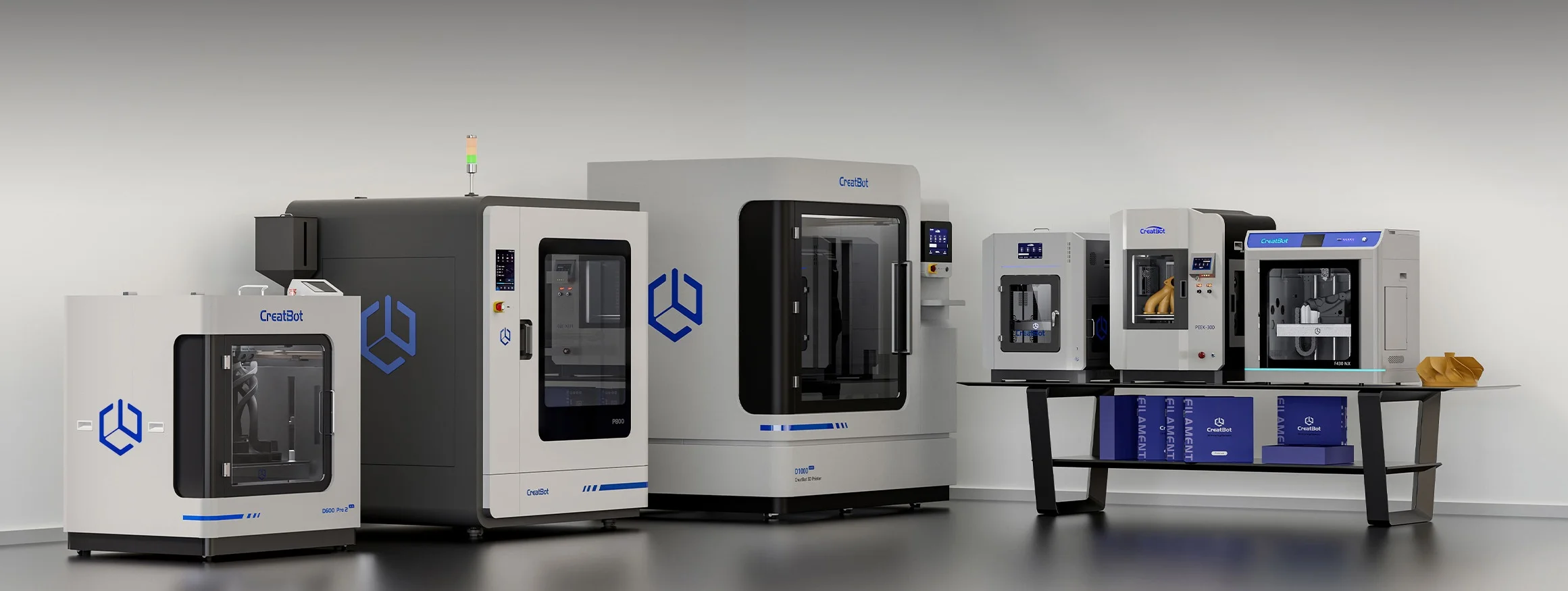
The build volumes of the 7 machines here, from largest to smallest, are: D1200 Ultra 1200×1050×1050 mm, D1000 Pro HS 1050×1050×1050 mm, D800 Ultra 800×650×650 mm, D600 Pro3 HS 620×620×620 mm, D400 HS 420×400×420 mm; the high-temperature models are PEEK-250 at 250×250×280 mm and PEEK-300 at 300×300×400 mm. Build volume is the limit on each of the length, width and height axes — the part must fit in all three directions (it can be rotated), not just along its longest edge. You also need margin for supports, fixtures and multi-part nesting, so the nominal figure does not guarantee a given part will fit.
RelatedD1200 Ultra product pageLarge-format machines explained
Besides PLA and ABS, what materials can a 3D printer use?
The machines here support 23 thermoplastic materials: general purpose PLA, PLA-CF, PETG, TPU 95A and PC; engineering ABS, ASA, ABS-FR, ASA-CF, PETG-ESD, Ultra PA, Ultra PA-CF, UltraPA-GF, PET-CF and PPS-CF; high performance PEEK, PEEK-CF, PEEK-GF, PEI1010 and PEI 9085; support materials PVA, S-270 and S-350. Material requirements for nozzle, bed and chamber temperature vary widely, so it is faster to work backwards from the material you need to the machine capability than to compare spec sheets one by one.
What accuracy can I expect, and is it the same as layer height?
The machines here state positioning accuracy as “±mm / 100 mm”: the Ultra series (D1200 Ultra, D800 Ultra) is ±0.05 mm per 100 mm, while the Pro series (D1000 Pro HS, D600 Pro3 HS, D400 HS) and the PEEK series are ±0.2 mm per 100 mm. Layer height is a slicing setting that determines surface stepping and print time, and is not the same metric as accuracy. Whether a part passes inspection also depends on material shrinkage, orientation and post-processing, so do not judge by the accuracy figure alone.
RelatedMachine spec comparison
For low-volume production, is 3D printing or injection molding cheaper?
Injection molding carries a fixed upfront tooling cost, so the fewer parts you make, the higher the unit price; 3D printing has no tooling cost and is usually more economical for tens to hundreds of parts while the design is still iterating, and only at higher volumes does molding's unit cost become clearly lower. The decision points are part count, whether the design is frozen, whether the material must be an injection-grade resin, and cosmetic requirements. All 7 machines here cover low-volume custom parts and prototype validation; suitability for continuous series production should be confirmed against the specific configuration.
RelatedMachine spec comparison
Buying an industrial 3D printer for the first time — what should I watch out for?
Four actions: print your own largest real part, a thin-walled part with holes and fine details, and an assembly part as samples; trial-print with the material you will actually use in production; write continuous operation, chamber temperature stability, material supply and after-sales response into the contract; and calculate cost per part instead of looking only at the machine price — in public data, material usually accounts for 20%-30% of part cost. The spec table here already lists build size, nozzle / bed / chamber limits, nozzle count and maximum speed, so you can screen out clearly unsuitable machines first.
RelatedMachine spec comparison
What kind of 3D printer is needed to print high-temperature materials such as PEEK and PEI?
PEEK requires a 400℃ nozzle, a 120℃ bed and a 70℃ chamber (PEEK-CF / PEEK-GF use a 100℃ bed); PEI1010 requires a 360℃ nozzle, a 140℃ bed and a 70℃ chamber; PEI 9085 requires a 320℃ nozzle, a 140℃ bed and a 90℃ chamber. Only the PEEK-250 (250×250×280 mm, single nozzle, 480℃ nozzle, 200℃ bed, 200℃ chamber) and PEEK-300 (300×300×400 mm, dual nozzle, 480℃ nozzle, 200℃ bed, 120℃ chamber) here support these 5 high-performance materials; the other 5 machines target general-purpose and engineering materials.
Contact Us


3D Printers
Message
Application Fields
Quick Links
