


In the wave of diversified retail formats and fragmented consumption scenarios, the vending machine industry is facing unprecedented challenges in customized demand. IVM Vending Machines has built a flexible manufacturing system by introducing CreatBot D600Pro2HS industrial-grade 3D printers in batches, successfully breaking through the constraints of traditional manufacturing models in terms of cost, cycle time, and design freedom. This case study will deeply analyze how IVM achieves small-batch customized production of large-scale vending machines through additive manufacturing technology, providing an innovative model for the digital transformation of retail equipment manufacturing.
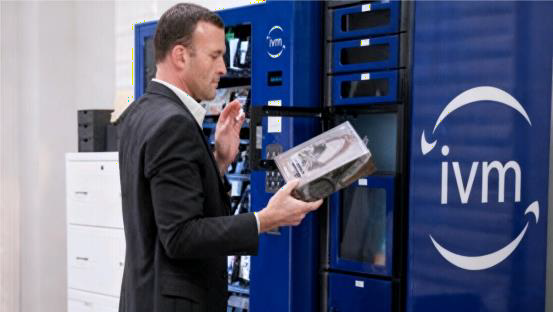
Intelligent Vending Solutions
Industry Pain Points: The Intense Collision Between Standardized Production and Customized Demands
As vending machine application scenarios expand from public places to corporate parks, medical institutions, transportation hubs, and other special environments, traditional manufacturing models expose three core pain points:
Economic Dilemma: Mold development costs account for 40%-60% of total small-batch order costs.
Delivery Cycle Pressure: From design confirmation to product delivery takes 12-16 weeks, missing market opportunities.
Innovation Bottleneck: Complex functional structures are limited by traditional processing techniques, with high design iteration costs.
IVM's biggest challenge lies in: how to meet customers' personalized needs for equipment specifications, functional modules, and appearance design without sacrificing economic benefits.
The Solution: CreatBot D600Pro2HS Builds Flexible Manufacturing Core
IVM's chosen CreatBot industrial-grade 3D printing solution reshapes the production system from three dimensions:
2.1 Core Equipment Advantages
Large-size Integrated Forming: 600×600×600mm forming space meets the integrated manufacturing needs of large panels and structural components.
High-temperature Material Compatibility: Supports PET-CF, UltraPA-CF and other engineering materials, ensuring component mechanical performance and environmental resistance.
Dual-nozzle Precision System: Perfectly presents complex internal structures.
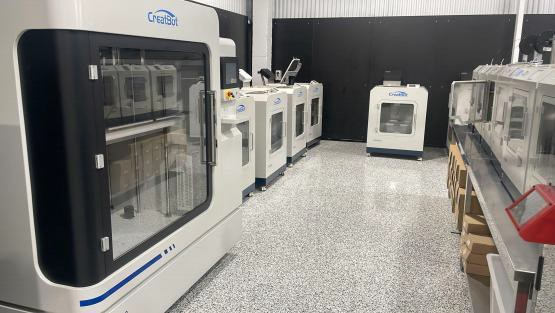
IVM's 3D Printing Factory
2.2 Innovative Production Model
IVM has established an agile process of "digital design - rapid printing - precise verification":
Customer customization needs are transformed into printable 3D models within 48 hours.
Structural components printed with PET-CF materials match the strength of traditional injection molded parts.
Special functional components (such as integrated cooling air ducts, cable management systems) achieve integrated manufacturing.
Results Demonstrated: Transformation from "Economies of Scale" to "Economies of Scope"
1. Economic Benefits Breakthrough
Small-batch order single machine cost reduced by 45%.
Product development cycle compressed from 16 weeks to 4 weeks.
Inventory costs decreased by 30%, achieving true on-demand production.
2. Product Innovation Achievements
Successfully developed medical-specific pharmaceutical vending machines with integrated temperature control modules and secure medication dispensing systems.
Customized AI interactive vending machines for technology companies, achieving complex sensor layout integration and lightweight structural design that reduces equipment weight by 25%, significantly lowering transportation and installation costs.
3. Quality Improvement Performance
3D printed structural components perform excellently in durability tests, with failure rates reduced by 30%.
Material consistency ensures each batch of products maintains the same quality standards.
Fast iteration mechanism allows design defects to be discovered and resolved early in product development.
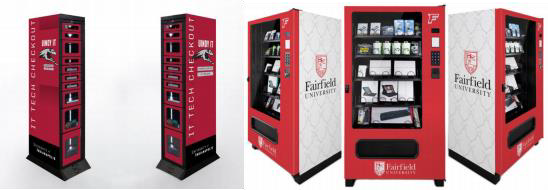
3D Printing Vending Machine Case Study
Strategic Insights: Digital Manufacturing Reshapes Industry Competitiveness
The IVM case proves that 3D printing technology is not just a production process, but a core driving force for enterprise strategic transformation:
- Supply Chain Reconstruction
Establish a distributed manufacturing network, allocate some production tasks to regional service centers, and achieve localized rapid response.
2. Business Model Innovation
Transform from equipment manufacturer to solution provider, obtaining premium space through rapid customization capabilities.
3. Technology Ecosystem Construction
Combine 3D printing with IoT and big data analytics to create an intelligent vending ecosystem.
Future Outlook
With continuous advancement in materials science and printing technology, additive manufacturing applications in the retail equipment field will expand to deeper levels:
Multi-functional integrated printing enables more complex electromechanical integration structures, sustainable material applications drive industry green transformation, AI-driven generative design further optimizes component performance. IVM company plans to achieve the goal of 85% 3D-printable components in next-generation products, ultimately building a completely digital manufacturing-based flexible production system.


