

Integrated PET-CF Lightweight Cockpit Rapid Prototype Validation and Industrialization Case Study
Summary
In the field of electric-mobility innovation, speed is the key to victory. This case demonstrates how the CreatBot D1000 HS industrial 3D printer joined forces with NIU Electric to break through traditional manufacturing bottlenecks: in only 65 hours it printed a single-piece 750 mm-long PET-CF carbon-fiber cockpit shell weighing just 2.4 kg, successfully achieving mold-free, high-strength, rapid-iteration prototype validation and setting a new benchmark of "speed plus performance" for large functional-part R&D.
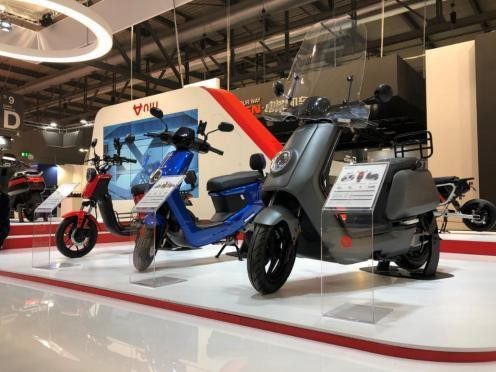
Personalized e-mobility manufacturing NIU
Industry Background & Challenges
In electric-vehicle innovation, product iteration speed and customization capability have become core competitiveness indicators. As a technology leader, NIU Electric needed a 1:1 functional prototype of its next-generation smart cockpit to verify structural integrity, ergonomic fit and aerodynamic performance through on-road testing and user research. Yet the company faced common industry challenges:
- R&D-cycle pressure: Traditional mold making takes months, unable to meet fast-iteration market demands
- Customization demand: Global markets increasingly require personalized vehicle configurations
- Cost control: Mold opening is extremely expensive, especially risky at the prototype-validation stage
- Global collaboration: Cross-continent R&D centers need synchronized development and data sharing
Solution: CreatBot Industrial 3D-Printing System
NIU Electric adopted the CreatBot D1000 HS industrial 3D-printing system to implement a digital prototype-manufacturing solution:
- Ultra-large build volume: 1000 × 1000 × 1000 mm, easily handling 750 mm large-part printing
- High-temperature printing: Supports high-performance composites, ensuring mechanical properties
- Stable & reliable industrial design: Guarantees 65-hour continuous printing stability and accuracy
- Global service support: Consistent technical support for Beijing and Munich R&D centers
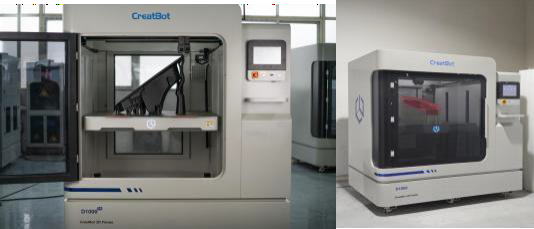
E-mobility base printing process CreatBot
Material Choice: PET-CF Composite
To meet structural-strength testing, assembly-accuracy verification and show-car quality, PET-CF composite was selected based on the following engineering considerations:
- Carbon-fiber reinforcement delivers up to 58 MPa flexural strength, ensuring load-bearing performance
- 0.8 % low shrinkage guarantees large-part dimensional stability, keeping assembly tolerance within ±0.15 mm
- 1.24 g/cm³ density enables lightweight design, 35 % lighter than conventional ABS
- Environmental-stress-cracking resistance meets outdoor-testing requirements
Implementation Results & Value
| Single-part print time | Part size | Material | Part weight |
|---|---|---|---|
| 65 h | 750 × 390 × 375 mm | PET-CF | 2.4 kg |
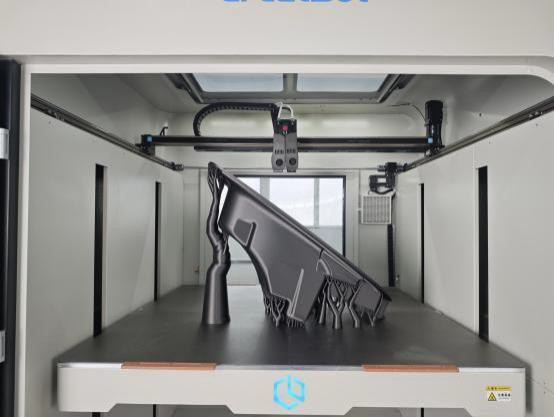
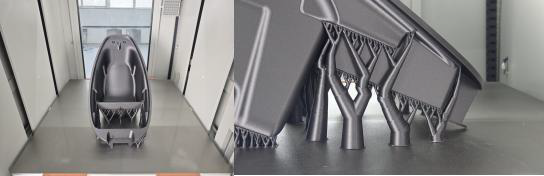
E-mobility base printing details CreatBot
1. R&D Efficiency Boost
- Prototype lead-time cut from weeks to 65 hours
- Design-iteration cycle shortened by 85 %, enabling synchronized China-Europe development & validation
2. Significant Economic Benefits
- Cost-effective solution for small-batch customized production
- Mold cost: ¥30 000 → 3D-printing cost ¥800/part; total development cost down 68 %, iteration count up 6×
3. Technology Upgrade Roadmap
- Beijing R&D center: first D1000 HS deployment & validation
- Munich R&D center: technology replication & expansion
- Dual-center collaborative development: build a global rapid-manufacturing network
- 2026 goal: mass production of end-user customized parts
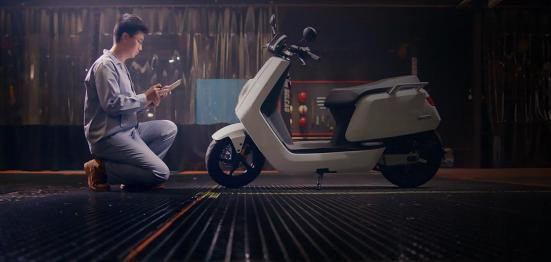
E-mobility base application scenario NIU
Future Outlook & Industry Significance
The cooperation between NIU Electric and CreatBot demonstrates a full industrialization path for industrial 3D printing in mobility manufacturing:
- Technology globalization: Successful cross-continent transfer and application of 3D-printing technology from Beijing to Munich
- Industrial upgrading: Established an evolution path from prototype validation to small-batch production and finally to scalable mass production
- Customization revolution: Provides technical assurance for mass-producing end-user customized parts by 2026
- Industry benchmark: Offers a successful model for digital-manufacturing transformation across the electric-mobility sector
Conclusion
This project not only verified the technical feasibility of the CreatBot industrial 3D printer for large functional-part manufacturing, but also revealed the industrial-application prospects of additive manufacturing in high-end industries. By introducing the CreatBot D1000 HS industrial 3D-printing system, NIU Electric successfully built a complete digital-manufacturing system covering prototype validation, small-batch production and future scalable customization.