


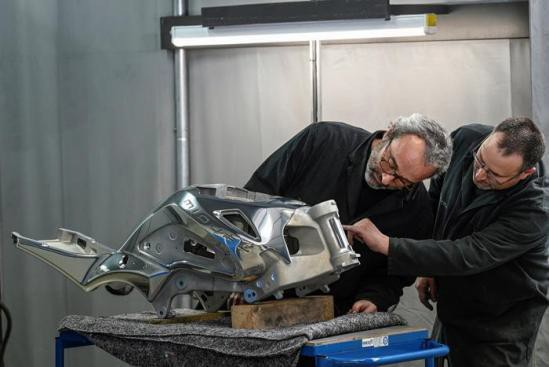
Bosch Mold Manufacturing Factory
As a global leader in automotive component supply, Bosch faces severe challenges in the field of mold manufacturing. The limitations of traditional manufacturing processes in terms of precision, efficiency, and cost are becoming increasingly prominent. This article details how Bosch has achieved a digital revolution in precision mold manufacturing by introducing CreatBot industrial 3D printers.
Industry Challenges
In modern automotive manufacturing, precision molds are key to ensuring product quality and production efficiency. With the increasing complexity of automotive design and the growing demand for personalization, mold manufacturing is facing unprecedented challenges.
Traditional manufacturing processes expose obvious shortcomings when dealing with these challenges: long manufacturing cycles, high costs, and limited design freedom. These problems severely restrict enterprises' innovation capabilities and market competitiveness.
Especially against the backdrop of the rapid development of new energy vehicles and autonomous driving technology, the complexity and precision requirements of components continue to increase, placing higher demands on mold manufacturing technology.
Traditional Manufacturing Limitations
Traditional mold manufacturing mainly relies on CNC machining and electrical discharge machining. Although these processes mature, they have obvious shortcomings when facing complex geometric shapes and special requirements:
- Material waste: The material removal rate of subtractive manufacturing is as high as 70-90%, and a large amount of expensive material is wasted
- Manufacturing cycle: The manufacturing cycle of complex molds usually takes 4-8 weeks, unable to meet the needs of rapid iteration
- Design limitations: Traditional processes struggle to achieve complex internal flow channels and conformal cooling channels
Additive Manufacturing Solution
Faced with the challenges of traditional manufacturing, additive manufacturing technology provides a brand-new solution. Through 3D printing technology, complex mold components can be manufactured directly from digital models, without molds, reducing material waste and shortening manufacturing cycles.
Bosch chose CreatBot industrial 3D printers for rapid manufacturing and end-use production of precision molds.
Why Choose CreatBot
- Large build volume: D1000 HS's 1000×1000×1000mm build volume can integrally print medium-sized injection molds
- High precision: ±0.2mm industrial-grade precision ensures mold dimensional accuracy
- High-performance materials: Supports high-temperature engineering materials and can be directly used in injection molding environments
- Stability: Industrial-grade design ensures stability for long-term continuous printing
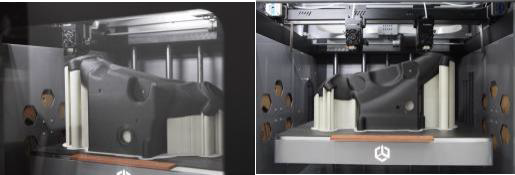
Bosch Mold Manufacturing Factory using CreatBot 3D Printer
Implementation Process
Digital Design
Engineers use CAD software for mold design, taking full advantage of the design freedom of additive manufacturing to optimize internal flow channels and cooling systems. Through topology optimization, lightweight design is achieved while ensuring strength.
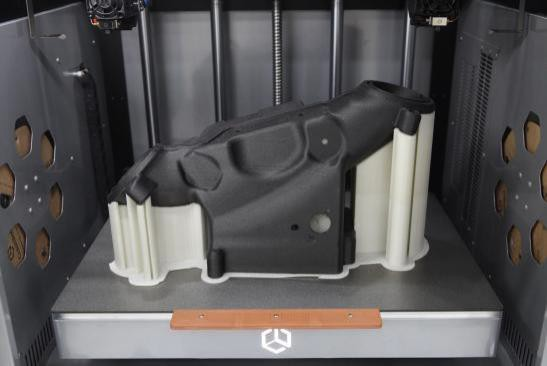
Digital Mold Design
Material Selection
Select appropriate printing materials based on the operating environment and performance requirements of the mold. For mold parts that require high temperature resistance, choose high-temperature engineering materials such as HTPA-CF; for ordinary mold parts, choose ABS or PC materials.
3D Printing Manufacturing
Use CreatBot D1000 HS for 3D printing of mold components. Real-time monitoring of key parameters such as temperature and laser power during the printing process to ensure manufacturing quality.
Mold Component 3D Printing Process
Post-Processing
After printing is complete, necessary post-processing procedures are performed, including support removal, surface treatment, and precision machining. Key mating surfaces are CNC finished to ensure dimensional accuracy and surface quality.
Implementation Results
By adopting CreatBot industrial 3D printers, Bosch has achieved significant results in mold manufacturing:
Efficiency Improvement
Mold delivery cycle has been shortened from the traditional 6 weeks to 2 weeks, with efficiency increased by 67%. The number of design iterations has increased by 3 times, significantly accelerating product development speed.
Cost Reduction
Material utilization has increased from 20% in traditional processes to over 90%, and material costs have been reduced by 80%. At the same time, post-processing procedures have been reduced, further lowering manufacturing costs.
Quality Assurance
Through strict process control and inspection methods, the quality of molds is ensured to meet the high-standard requirements of automotive components. The design of conformal cooling channels optimizes the injection molding process and improves product quality.
Conclusion
Bosch's successful case proves the enormous value of additive manufacturing technology in the field of precision mold manufacturing. CreatBot industrial 3D printers not only solve the technical problems of traditional manufacturing but also achieve significant economic benefits and quality improvements. As technology continues to mature, additive manufacturing will be more widely applied in the field of mold manufacturing.


