


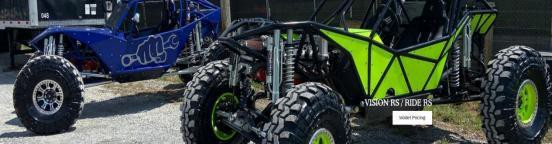
—— From weeks of waiting to 48-hour rapid iteration, achieving double leap in performance and cost efficiency
Facing intense off-road racing competition and tight modification windows, professional modification brand Busted Knuckle Offroad introduced the CreatBot D600Pro 2 HS industrial-grade 3D printer, using PA-CF material for integrated printing of high-performance intake manifolds. They reduced development cycles from 3-4 weeks to 48 hours, cut unit costs by over 80%, and validated exceptional performance and reliability in world-class competitions, significantly boosting racer performance.
Industry Pain Points: Traditional Manufacturing Can't Keep Up with Modern Racing's Agile Demands
For top off-road motorcycle modification brands like Busted Knuckle Offroad, upgrading engine intake manifolds is a key step in unlocking performance potential. However, they long relied on traditional aluminum CNC machining and welding processes, which face severe challenges in agility and economics:
Efficiency Bottlenecks
From design finalization to obtaining usable test parts, the lengthy CNC programming, machining, and post-processing process takes 3-4 weeks. This is an unacceptable delay for rapidly changing race preparation and short modification windows.
High Costs
The small-batch, customized nature keeps mold costs high, often exceeding $5,000 for a single set of intake manifold mold development, greatly limiting the frequency of design iteration and new solution validation.
Design Limitations
Separate welding processing introduces cumulative assembly errors of up to ±1.2 mm, and complex internal structures (such as optimized airflow channels, integrated dust separation devices) are difficult to implement, restricting further performance breakthroughs.
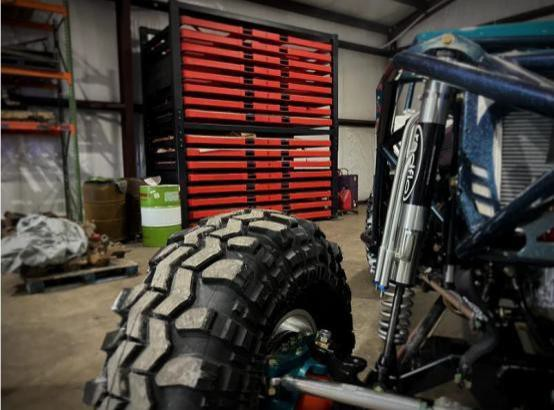
Technical Breakthrough: Creatbot D600Pro 2 HS 3D Printing Integrated Solution
Busted Knuckle Offroad introduced the Creatbot D600Pro 2 HS high-performance industrial 3D printer, whose core advantages comprehensively surpass traditional processes:
Significantly Reduced Lead Time
Realize rapid "design-print-test" closed loop, completing iterations within 48 hours
Dramatically Lowered Costs
No expensive molds needed, direct unit manufacturing cost is only a fraction of traditional methods
Unleashed Design Freedom
Integrated printing avoids welding errors, enabling complex aerodynamic shapes and built-in functional structures
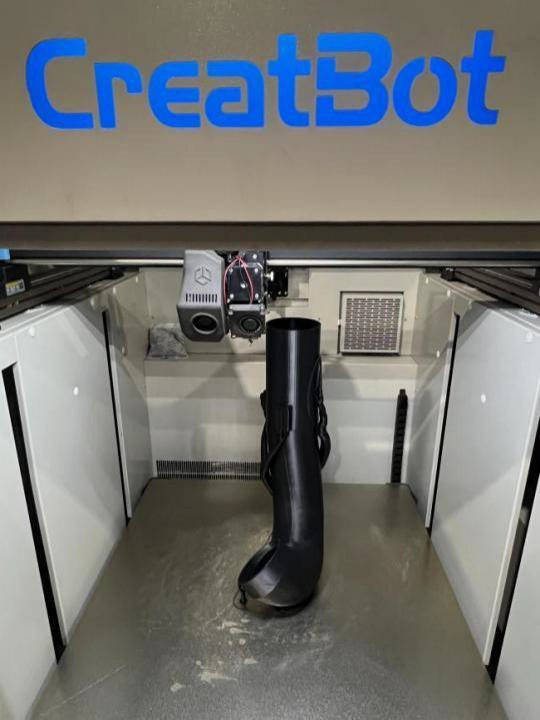
Performance Challenges and Engineering Solutions
Why 3D Printed PA-CF Material is the Ideal Choice
The engine intake manifold is the "respiratory organ" of the engine, and its performance directly affects the engine's power output, efficiency, and reliability. Especially in harsh off-road environments, it must meet the following core requirements:
1. Extremely High Heat Resistance
The engine compartment is a high-temperature environment, especially near the engine itself. The intake manifold must be able to withstand sustained high temperatures of 80-120°C for long periods and briefly endure peak thermal radiation above 140°C in the engine compartment without softening, deformation, or performance degradation.
2. Excellent Mechanical Strength and Rigidity
Off-road environments are extremely bumpy; insufficient strength can lead to part fatigue and fracture. Insufficient rigidity may cause component resonance, leading to detachment of fixed points or interference with other components.
3. Outstanding Material Stability and Sealing
Various oils and fluids are unavoidable in the engine compartment; if the material is corroded, it will quickly age and fail. Sealing is the foundation for precise control of the Engine Control Module (ECM).
4. Extreme Internal Surface Finish and Airflow Optimization
The inner wall of the pipe must be as smooth as possible to reduce intake resistance. The shape design must conform to aerodynamics, ensuring smooth, high-speed airflow into the cylinders and avoiding turbulence.
5. Lightweight
Reducing unsprung mass and sprung mass is key to improving vehicle handling and response speed. As part of the engine, weight reduction of the intake manifold has a positive impact on improving power response.
Our customized solution: Facing the above demanding conditions, traditional manufacturing methods are costly and time-consuming. Busted Knuckle Offroad, through Creatbot D600Pro 2 HS industrial-grade 3D printing and advanced material technology, provides the perfect solution.
How Our Solution Achieves This
1. Material Selection: High-Performance PA-CF (Carbon Fiber Reinforced Nylon)
Heat Resistance
PA-CF material has a high heat deflection temperature (HDT) of 140°C, fully meeting or even exceeding the continuous heat resistance requirements in the engine compartment.
Strength and Rigidity
Carbon fiber filaments uniformly distributed in the nylon matrix greatly enhance the material's rigidity and impact resistance. Its strength-to-weight ratio far exceeds ordinary aluminum alloy, achieving a 38% weight reduction while ensuring sufficient mechanical strength to withstand off-road impacts.
Chemical Stability
PA-based materials inherently have good resistance to oils and chemicals, ensuring long-term durability in the engine compartment environment.
2. Integrated Printing Manufacturing
Air Tightness and Structural Integrity
Utilizing the large build volume (600x600x600mm) of D600Pro 2 HS, we achieved integrated printing of the intake manifold. This fundamentally eliminates the leakage risks and cumulative errors that may be caused by traditional welding processes, ensuring absolute air tightness and design accuracy.
Design Freedom and Airflow Optimization
3D printing technology enables us to break through the limitations of traditional manufacturing, designing and manufacturing complex structures with more optimized internal airflow channels and shapes that better conform to aerodynamics. We can iterate quickly until we obtain the model with optimal performance.
3. Precise Post-Processing
Connection and Sealing: Precisely process key connection parts such as mounting flanges to ensure perfect alignment with the engine and throttle body, and install high-quality sealing rings to achieve reliable sealing.
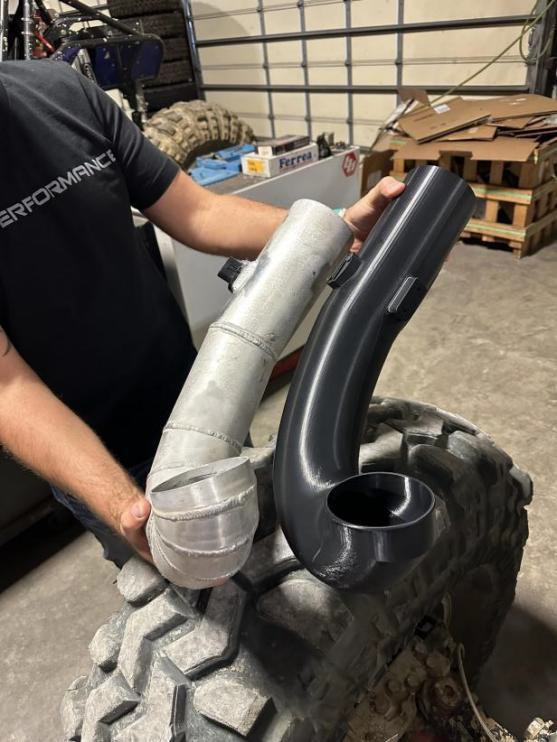
1:1 printed finished product of engine intake manifold
Exceptional Performance: Comprehensive Validation from Laboratory to Peak Competitions
Phase 1: Extreme Environment Laboratory Testing (Q3 2023)
- Excellent weather resistance: Continuous operation for 50 hours at 85°C/95% humidity without deformation
- Lightweight champion: 38% weight reduction compared to aluminum alloy parts (620g→385g)
Phase 2: Practical Validation in Global Top Competitions (2024 Season)
King of the Motos Competition
15% reduction in power loss under plateau conditions, won second place
Sea to Sky Competition
300% extension of air filter replacement interval, successfully completed the race
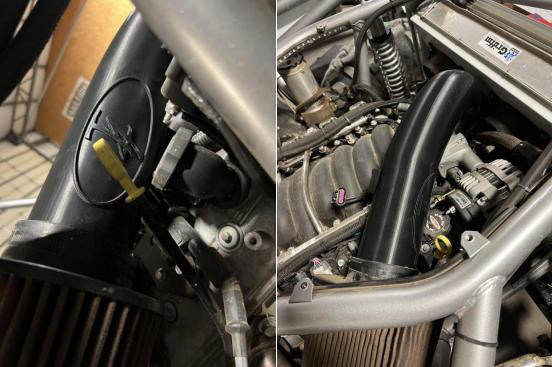
Actual application scene of engine intake manifold
Economic Benefit Analysis: Reshaping Cost Structure, Empowering Business Growth
Traditional CNC solution: approximately $5,200 (calculated by amortizing $5,000 mold cost over small batch)
VS
3D printing solution: printing cost (material + energy): $320, post-processing (surface finish, etc.): $150
Total cost: ~$470
Savings exceed 90%
Savings exceed 90%, allowing the team to conduct design experiments more freely and develop dedicated components for more vehicle models.
Conclusion and Outlook
Busted Knuckle Offroad's successful case demonstrates the enormous value of additive manufacturing technology in high-performance, small-batch customized industrial applications. The Creatbot D600 Pro 2 HS printer not only solves specific engineering problems but also helps customers reshape product development processes and establish brand-new competitive advantages.
In the future, the team plans to apply 3D printing technology to more key components such as engine brackets and lightweight structural parts, continuously promoting the innovative development of off-road motorcycle modification technology.


