


16th CIRP Conference on Intelligent Computation in Manufacturing Engineering, CIRP ICME '22, Italy
Preliminary test on the effect of direct annealing on additive manufactured PEEK bending properties
Luigi Morfinia, *, Maria Grazia Guerraa, Fulvio Lavecchiaa, Roberto Spinaa, b, c, Luigi Maria Galantuccia
a Dipartimento di Meccanica, Matematica e Management (DMMM), Politecnico di Bari, Bari, Italy
b Istituto Nazionale di Fisica Nucleare (INFN)-Sezione di Bari, Bari, Italy
c Consiglio Nazionale delle Ricerche-Istituto di Fotonica e Nanotecnologie (CNR-IFN), Bari, Italy
Abstract
Engineering polymers are widely used in aerospace, automotive, aviation, and biomedical industries. They can be processed with different technologies and Additive Manufacturing. Polyether ether ketone (PEEK) is a semi-crystalline polymer that exhibits excellent mechanical properties and resistance to high temperatures. Being a semi-crystalline polymer, heat treatments can be used to improve its properties. They can be conducted in the oven or through a direct annealing system included in the Fused Filament Fabrication (FFF) machine. This study aims to provide more information on the correlation between annealing and the flexural properties of PEEK specimens made by FFF technology. A direct annealing process, performed during the printing, was carried out and compared with a traditional oven annealing with similar duration. The flexural properties were analyzed as a function of the annealing type and temperature.
© 2023 The Authors. Published by Elsevier B.V.
This is an open access article under the CCBY-NC-ND license (https://creativecommons.org/licenses/by-nc-nd/4.0)
Peer-review under responsibility of the scientific committee of the 16th CIRP Conference on Intelligent Computation in Manufacturing Engineering
Keywords: Fused filament fabrication; PEEK; Annealing; Flexural strength; Additive manufacturing
1. Introduction
Additive Manufacturing (AM) processes with polymers are continuously used in aerospace, automotive, aeronautical, biomedical, and energy for prototyping and fabricating functional parts with the release of new high-quality materials [1]. Polyether ether ketone (PEEK) is a linear, aromatic, semi-crystalline thermoplastic [2] employed in these fields for its excellent thermal, chemical, and mechanical properties [3]. PEEK processes, such as injection molding, or the more recent AM powder bed fusion processes, such as Selective Laser Sintering (SLS) or Direct Energy Deposition (DED). In recent years, efforts have been made to produce PEEK parts using Fused Filament Fabrication (FFF) to reduce production costs [4]. Although FFF is increasingly seen as a user-friendly technology, obtaining good printing results with PEEK requires significant effort due to the specific material and process features. Several parameters influence the results, mainly printing temperature, layer height, and printing speed [5]. El Magri et al. [6] performed a Design of Experiments (DoE) analysis on the main FFF process parameters, revealing that the extrusion temperature was the most influential on tensile properties and the crystallinity degree of printed PEEK. Other parameters concerning deposition strategies, such as infill density and infill raster angle, were significant on tensile and flexural properties [7], [8]. The parameters mentioned above are crucial since they directly affect the interlayer adhesion. In this regard, PEEK specimens printed with non-optimized parameters showed lower mechanical properties than specimens in Acrylonitrile Butadiene Styrene (ABS) with optimized parameters, according to Wu et al. [9].
Significant studies were carried out on PEEK, including Differential Scanning Calorimetry (DSC) analysis and other methods in establishing a thermal profile of the material. Jin et al. [10] found that the double melting peaks in the DSC analysis originated from the reorganization of PEEK crystals due to the faster recrystallization rate of PEEK than the imposed heating and cooling rates. According to Liaw et al. [11], the analysis of the degree of crystallinity pointed out the importance of obtaining a high value to improve the interlayer bonding adhesion, leading to high mechanical properties. A higher crystallinity was obtained by raising the nozzle temperature and the layer height, whereas lowering the waiting time before part removal and the print speed. Since PEEK is a semi-crystalline polymer, it is essential to investigate the possibility of increasing the crystallinity of PEEK printed parts through post-printing heat treatment. As for other polymers, melt underwent a complex deformation and cooling history, resulting in an inhomogeneous microstructure distribution in the component, as Laschet et al. [12] reported. Yang et al. [13] showed how different heat treatment methods affected PEEK crystallinity, which locally affected mechanical properties. The literature reported air cooling, furnace cooling, quenching, annealing, and tempering. Annealing results showed to be better for getting a higher degree of crystallinity. Basgul et al. [14] studied how the structure of the pores of PEEK parts changed after annealing without gaining a decrease in the undesired porosity formed during the 3D printing process, which was due to interlayer debonding. Another research showed that annealing gave good results on mechanical, tribological, and viscoelastic properties [15]. Regis et al. [16] studied the behavior and crystallinity of injection-molded PEEK specimens undergoing annealing treatment at 200°C to 300°C. The result reported higher crystallinity achieved by performing treatments at higher temperatures.
This study aims to provide more information on the correlation between annealing and the flexural properties of PEEK specimens made by FFF technology. A direct annealing process, performed during the printing, was carried out and compared with a traditional oven annealing with similar duration. The flexural properties were analyzed as a function of the annealing type and temperature.
2. Material and methods
The material used was the PEEK KetaSpire®MS NT1 AM 1,75mm from Solvay SA (Brussel, Belgium), a natural filament able to provide long-term performance up to 240°C. Its high resistance to corrosion, chemicals, heat, ductility, and dimensional stability makes it suitable for applications such as metal replacement in aerospace, automotive, and Oil & Gas. The melting temperature declared by the supplier is 343°C [17], and the glass transition temperature is about 145°C [14]. The spool was dried for eight hours at 150°C in an air circulating oven and stored in vacuum bags until printing. According to UNI EN ISO 178 [18], the bending specimens' dimensions were 80×10 mm² and 4 mm thickness. Specimens were produced with a Creatbot PEEK-300 coreXY 3D printer with a build volume of 300×400×300mm³ in a fully enclosed hot chamber.
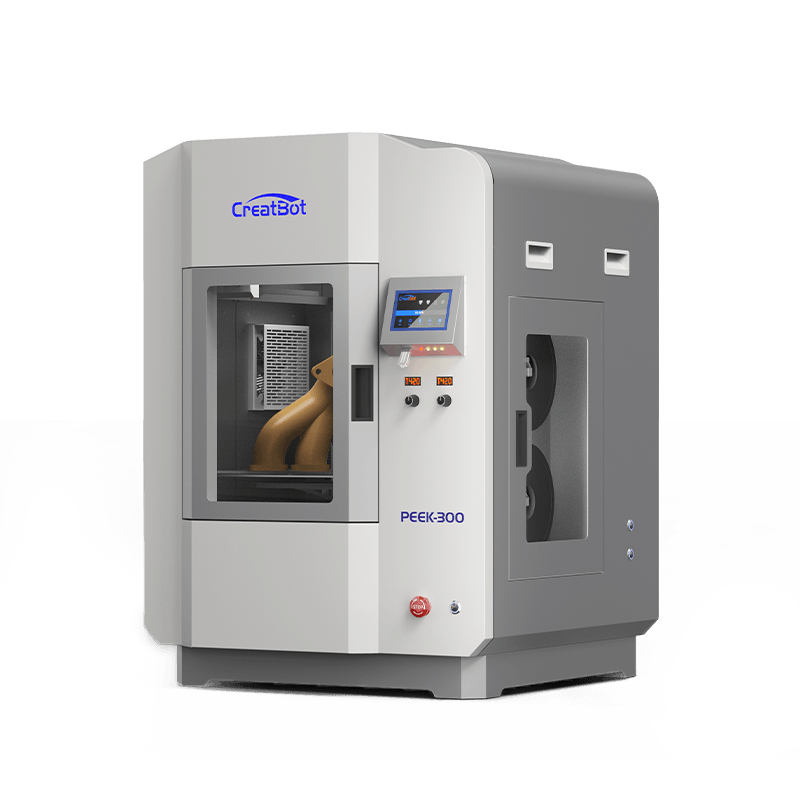

Fig.1. Direct annealing system.
It was equipped with a dual extruder system. The max temperatures of the nozzles, platform, and chamber, were 500°C, 200°C, and 120°C, respectively. One of the additional primary features of this machine was the Direct Annealing System (DAS), a company technology to anneal the part during deposition. The supplier declared that the DAS technology was patent-protected and available only on CreatBot machines. A corona-shaped heated element was used to maintain the area surrounding the deposition nozzle on the last layer at a controlled temperature (Fig. 1). The direct annealing advantage was improving the bonding strength between layers, avoiding problems related to layer delamination. A 0.4 mm hardened steel nozzle and a carbon fiber plate were used during the experiments.
Preliminary printing tests were performed to evaluate the adhesion to the printing platform. A specific high-temperature glue guaranteed printing platform adhesion along 15 brim lines. Initial printing tests were carried out using parameters found in the literature and reported in Table 1.
Table 1. Printing parameters.| Parameter | Value | Unit |
|---|---|---|
Temperatures | ||
Nozzle | 430 | °C |
Platform | 150 | °C |
Chamber | 100 | °C |
Shell | ||
LayerHeight | 0.2 | mm |
LineWidth | 0.4 | mm |
WallLayerCount | 3 | - |
Infill | ||
InfillDensity | 100 | % |
InfillAngleOffset | -45°/+45° | - |
Speed | ||
Printingspeed | 20 | mm/s |
A factorial 22 DoE was used to study the direct annealing process's influence and to compare it with the classical one conducted in the oven. A 22 DoE was chosen because the process was in an exploration phase. Table 2 reports the factors and relative levels selected for the analysis, with three replications for each combination. Investigated factors were the type of annealing and the maximum temperature. Fifteen specimens were manufactured. Six were subsequently treated in the oven, whereas the other six underwent direct annealing. The remaining three remained untreated.
| Process | Direct Annealing (DA) | Oven Annealing (OA) |
|---|---|---|
Temperature(°C) | 200 | 300 |
Factor Level

Fig.2.Annealing cycle.
The printing time of each specimen was equal to 40 minutes. The direct annealing process time was the same as the printing time because the hot crown carried out the treatment while the tip deposited the fused filament. The oven treatment time was the same as the direct annealing to make the experiment results comparable. The heating and the cooling rate used were equal to 5°C/min. The thermal cycle is reported in Fig. 2.
2.1. Time and Cost Analysis
The analysis of time and cost factors was also performed. Times are summarized in Table 3. Printing time tprint was the same for each specimen and treatment. Annealing time in the oven comprised the heating and the holding times.
Table 3. Table of printing and annealing times.
| Direct Annealing | Oven Annealing | |||
|---|---|---|---|---|
| Time(min) | 200°C | 300°C | 200°C | 300°C |
| ID | DA200 | DA300 | OA200 | OA300 |
| Annealing time (toven) | - | - | 75 | 95 |
Hour rates were related to the 3D printer (Cp), oven (Co,Cco), printing (Ccp), and direct annealing (Ca, Cda). The purchasing price of the material, equal for both processes, was considered neglectable. A machine hour rate is an hourly cost in terms of factory overheads to operate a particular machine. It is obtained by dividing the factory expenses associated with the machine for a given period by the number of hours worked by the machine during that period. For this reason, the hour rates were the following:
The production costs of a part with direct annealing CDA andoven annealing COA were:
The formulas (1) and (2) have several elements in common (Cp, Ccp) that can be ignored to highlight the difference in cost between the two processes.
The specific costs of the single treatments are, therefore:
Assuming an hourly cost of 0.5 €/h for the direct annealing equipment, a direct annealing system power consumption of 80 Wh, a heat treatment oven hourly cost of 10.0 €/h, and an oven power consumption of 2,200 Wh, the treatment of the oven was significantly more expensive, with equation (2) greater than equation (1).
3. Results and Discussion
3.1. Mechanical tests
Three-point bending tests were executed to evaluate the influence of the two annealing treatments on the material's mechanical properties (Fig.3). The results (Fig.4) pointed out that the effect of the heat treatment was substantial, varying the flexural strength with respect to the untreated specimens. The average flexural strength of the untreated specimens (UNT) was 124.43 MPa, with a standard deviation of 6.75 MPa, similar to those reported in the literature [19]. The annealing process at high temperatures improved the mechanical properties of thermoplastics, as highlighted by Butt and Bhaskar [20], studying the influence of annealing on commonly used polymers. For this reason, an increase in properties was expected in PEEK. The specimens undergoing annealing treatment in the oven at 300°C (OA300) reported a 16% higher flexural strength than UNT, as confirmed by some works [14], [15]. Moreover, annealing improved mechanical properties at high heating temperatures thanks to a higher interlayer bonding adhesion [21]. Interlayer bonding adhesion is a crucial factor in mechanical testing to evaluate stresses. Improving bonding adhesion led to a reduction of material’s porosity, getting closer to the properties of the same material processed by injection molding [6]. However, the OA300 specimens showed more brittle behavior, with 66% of broken specimens. All the other samples did not reach specimen failure at the end of the test.
The specimens undergoing the direct annealing treatment at 300°C (DA300) did not reach the same Flexural Strength values of OA300. They showed an almost 6% flexural strength increase with respect to the untreated specimens, getting an average Flexural Strength of 131.77 MPa and a standard deviation of 3.30 MPa. On the other hand, specimens treated at 200°C showed a mechanical properties deterioration.

Fig.3. Bending specimens before and after mechanical testing.

Fig.4. Percentage values of flexural strength of heat-treated specimens compared to untreated specimens (0%).
As a result, the properties worsened by 6.5% for the oven-treated specimens at 200°C (average 116.2 MPa, standard deviation 19.41 MPa) and 5% for the directly treated ones at 200°C (average 118.3 MPa).
3.2. Statistical Analysis
Statistical analysis was performed. The input factors (treatment, treatment temperature) were selected for their remarkable impact on the mechanical properties. Previous works [6], [14] have shown interest in conducting annealing cycles at 200°C and 300°C. Data related to Flexural Strength of the 12 specimens subjected to heat treatment, previously obtained from mechanical tests, were analyzed. In the ANOVA analysis with a confidence interval of 95%, only the treatment temperature was influential (p-value 0.016). This behavior was also visible from the main effects plot (Fig. 5).

Fig. 5. Main effects plot for flexural strength.
The graph shows that the type of treatment had little influence on flexural strength. On the other side, the treatment temperature resulted as significantly influential, confirming the trend of the previously analyzed literature [6], [11], [16].
3.3. SEM Analysis
Scanning Electron Microscope (SEM) assessed changes in the material structure caused by annealing (Fig. 6). Direct and oven annealing at 300°C improved the bonding between layers, confirming the results of the mechanical tests and the literature review. The bending test specimens analyzed in this paper showed similar behavior, highlighting the main criticality of separating layers due to the stresses introducedby the bending test. There were areas of discontinuity between layers in the specimens with lower flexural strength, evidenced by delaminations and voids. Fig. 6-a shows the UNT specimen as a reference before mechanical testing. The printing process caused low adhesion between the layers. Fig. 6 showed directly treated and oven treated specimens’ cross-sections images, analyzed after mechanical testing. DA200 was very similar to UNT, highlighting how the treatment may have had no effect and, as in the case examined, led to lower values of flexural strength. Fig. 6-c showed the same behavior as Fig. 6-b. Gaps between layers, incentivized by bending, are the leading cause of the deterioration of bending properties.

Fig.6. SEM images of specimen cross-sections: (a) printing orientation (xy) with cross-section highlighted (zy); (b) UNT; (c) DA200; (d) OA200; (e) DA300; (f) OA300.
In contrast, specimens treated at 300°C were more compact. This behavior confirmed what was obtained from the mechanical tests, achieving more improved flexural properties. The samples had fewer gaps between the layers. DA300 had some gaps, affecting the values obtained from the tests. OA300 was the most compact, and its results were the best in terms of flexural strength but showed lower deformation before breaking. The gaps in DA200 and OA200 were broader and deeper than those in DA300 and OA300.
4. Conclusions
This paper deals with the mechanical characterization of PEEK subjected to a direct annealing process. A comparison between this annealing and oven annealing was made. The data analyzed as a function of the treatment type, direct or in the oven, did not significantly affect the flexural strength, while the temperature was influential. Analyses have shown that the most suitable treatment is the one at 300°C. The mechanical properties of flexural strength gained an increase of 16% and 6%, respectively, for oven annealing and direct annealing. The treatment in the oven at 300°C increased the mechanical performance by 10%. Still, it required a total time of production (printing plus oven annealing time) of 3.5 times compared to the total production time with direct annealing. Direct annealing (DA300) was evident considering production time, reduced to just the printing time, and, consequently, costs. Generally, the activation of the direct annealing system gave benefits to the printing process of PEEK. Direct annealing conducted at 300°C made it possible to obtain a better printing quality, improved bonding adhesion, and improved flexural strength, with a negligible increase in cost, due to the different electrical consumption, with respect to the untreated parts.
Acknowledgments
The Italian Ministry of Education supported this work, University and Research under the Program “Department of Excellence” Legge 232/2016 Grant No. CUP - D94I18000260001. The research was part of the research project PON SIADD – “Innovative solutions for the quality and sustainability of additive manufacturing processes” CUP B36G18001430005, funded by National Operational Program PON - Research and Innovation 2014-2020.


